⚡ Quick Answer WordPress and DNN (DotNetNuke) are both CMS platforms, but they serve very different audiences. WordPress runs on PHP and powers 43% of the web — it is ideal for SMBs, bloggers, D2C brands, and service businesses. DNN runs on Microsoft .NET and is built for enterprise IT teams, government portals, and organisations already embedded in the Microsoft ecosystem. For 95% of Indian businesses, WordPress is the right choice.
If you’ve landed on this page, you’re probably evaluating two very different tools for a very specific reason. Maybe your Google Search Console is showing impressions for this query. Maybe a client is asking whether to stick with their DNN setup or migrate to WordPress. Or maybe someone in IT mentioned DotNetNuke and now you’re wondering what it actually is.
This guide gives you a complete, honest, India-grounded answer — not a generic spec comparison, but a practical framework for making the right decision for your specific situation.
What Is WordPress?
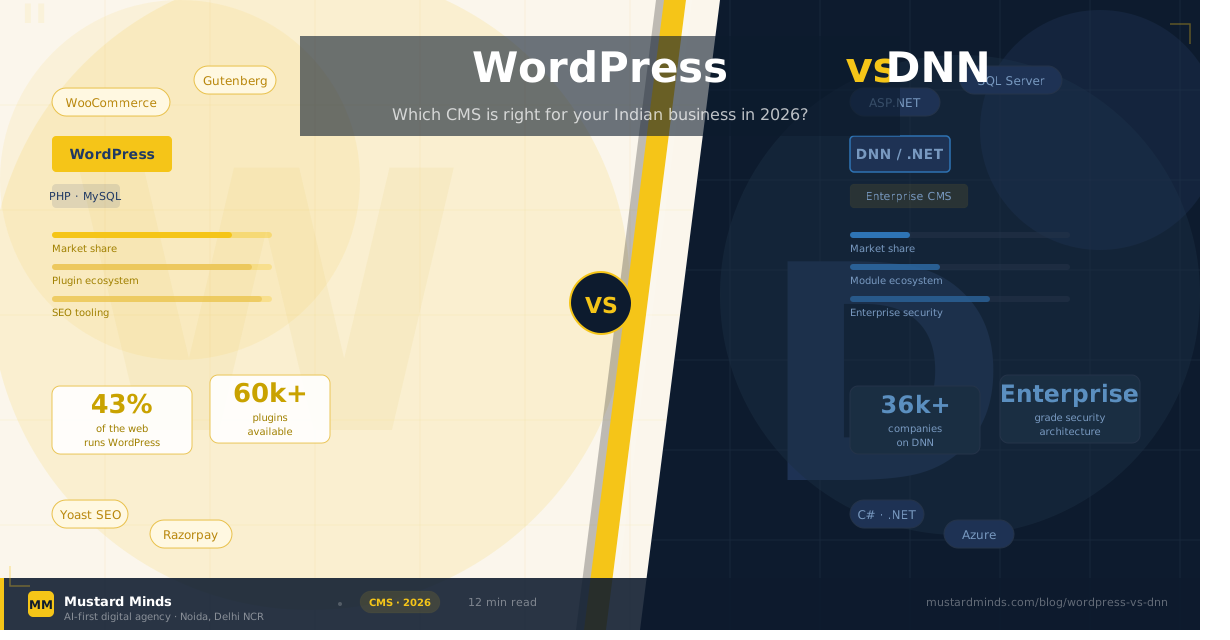
WordPress is an open-source content management system (CMS) built on PHP and MySQL. Originally launched in 2003 as a blogging platform, it has evolved into the world’s most widely used CMS — powering 43% of all websites on the internet as of 2026.
WordPress comes in two flavours: WordPress.com (the hosted platform) and WordPress.org (self-hosted, open source, and what most agencies mean when they say “WordPress”). The self-hosted version gives you complete control over your code, database, hosting, plugins, and design.
Its ecosystem is vast: over 60,000 plugins, thousands of themes, and a global community of millions of developers, designers, and content creators. For Indian businesses specifically, WordPress has become the default platform for business websites, blogs, news portals, and WooCommerce-powered e-commerce stores.
What Is DNN (DotNetNuke)?
DNN, short for DotNetNuke, is an open-source CMS built on Microsoft’s ASP.NET framework. Originally released in 2002, it was one of the first enterprise-grade .NET CMS platforms available as open source.
DNN is available in three editions: Community Edition (free, open source), Evoq Content (professional, commercial), and Evoq Engage (enterprise, with community features). It is primarily used by large organisations with existing Microsoft infrastructure — think Azure hosting, SQL Server databases, and Windows Server environments.
While WordPress has grown to dominate the broader CMS market, DNN has maintained a loyal base in enterprise IT, government agencies, higher education institutions, and Microsoft-stack development shops. It is well-regarded for its role-based permission system, enterprise-grade security architecture, and native integration with .NET development workflows.
Key distinction WordPress is a PHP-based CMS built for the open web. DNN is a .NET-based CMS built for the Microsoft enterprise stack. They are not really competing for the same customers — which is the most important thing to understand before choosing between them.
WordPress vs DNN: Head-to-Head Comparison (2026)
Let’s compare both platforms across the dimensions that matter most to Indian businesses evaluating a CMS decision.
| Factor | WordPress | DNN (DotNetNuke) |
|---|---|---|
| Technology stack | PHP + MySQL | ASP.NET + SQL Server |
| Hosting environment | Any Linux/Windows host | Windows Server + IIS required |
| Cost to get started | ₹0 (open source) + hosting from ₹2,000/yr | ₹0 community + expensive Windows hosting |
| Themes / design | 10,000+ themes, highly customisable | Limited theme ecosystem |
| Plugin / module ecosystem | 60,000+ plugins | Smaller, commercial-heavy marketplace |
| SEO capability | Excellent (Yoast, RankMath, schema tools) | Basic; requires manual configuration |
| Ease of use for non-devs | Very high — intuitive block editor | Moderate — more technical UI |
| Developer talent availability | Abundant globally and in India | Scarce; .NET/DNN specialists are rare |
| Security | Good when maintained; plugin risks exist | Enterprise-grade, .NET security model |
| Scalability | High with caching, CDN, managed hosting | High — designed for large enterprise |
| E-commerce | WooCommerce — excellent | Limited native e-commerce capability |
| Multilingual support | WPML, Polylang plugins | Built-in multilingual (enterprise editions) |
| Hosting cost in India | ₹2,000–₹20,000/year | ₹8,000–₹60,000/year (Windows hosting) |
| Community size | Massive, global, active | Small, enterprise-focused |
| Best for | SMBs, D2C, blogs, service businesses | Enterprise, government, .NET organisations |
The Detailed Breakdown: 8 Factors That Matter
1. Technology Stack and Hosting
This is the fundamental fork in the road. WordPress runs on PHP, which is supported by virtually every hosting provider in India — from ₹2,000/year shared hosts to premium managed WordPress hosting on Google Cloud or AWS. You can spin up a WordPress site on any of the major Indian hosting providers (Bluehost India, Hostinger, BigRock, SiteGround) without any specialist knowledge.
DNN requires a Windows Server environment running Microsoft IIS (Internet Information Services). Windows hosting in India costs significantly more than Linux hosting and has far fewer provider options. If your organisation already runs Azure, this is a non-issue. If you’re a small business looking for affordable hosting, Windows hosting adds immediate and ongoing cost.
2. Cost of Ownership
WordPress has a near-zero cost of entry. The CMS itself is free, themes start at ₹0, and most essential plugins are either free or low-cost annual licences. A typical WordPress business website costs ₹25,000–₹80,000 to build professionally and ₹5,000–₹15,000/year to maintain.
DNN community edition is also free, but the enterprise editions (Evoq Content, Evoq Engage) carry commercial licence costs that are significant. Combined with Windows hosting costs and the scarcity of DNN-specialist developers in India (who charge premium rates), total cost of ownership for a DNN site is materially higher for most organisations.
3. SEO Capability
This is one of WordPress’s clearest advantages. The WordPress SEO ecosystem is unmatched — tools like Yoast SEO and RankMath give you full control over meta tags, structured data, XML sitemaps, canonical URLs, breadcrumbs, and schema markup, all through a user-friendly interface.
DNN has basic SEO capabilities built in, but lacks the depth of WordPress’s plugin ecosystem for SEO. Advanced structured data implementation, automated schema generation, and real-time on-page SEO analysis all require custom development in DNN rather than a plugin install.
For any Indian business where organic search traffic is a priority — and it should be for most — WordPress has a measurable SEO advantage.
Mustard Minds note Every WordPress site we build at Mustard Minds includes Yoast or RankMath configuration, full schema markup, XML sitemap, and Core Web Vitals optimisation as standard. This SEO infrastructure would require significant custom development to replicate in DNN.
4. Developer Availability in India
This is a practical consideration that often gets overlooked in CMS comparisons. India has one of the largest pools of WordPress developers in the world. You can find experienced WordPress developers at every price point, from freelancers at ₹500/hour to senior agency developers. The talent market is deep, competitive, and geographically distributed.
DNN developers in India are significantly scarcer. DNN development requires knowledge of ASP.NET, C#, and the DNN module development framework — a specific combination that fewer Indian developers have. This scarcity drives up rates, extends hiring timelines, and creates dependency risk: if your primary DNN developer leaves, finding a replacement takes considerably longer.
5. E-commerce
For Indian D2C and e-commerce businesses, WordPress with WooCommerce is the dominant choice. WooCommerce is mature, flexible, and deeply integrated with the Indian payment ecosystem — Razorpay, PayU, CCAvenue, PhonePe, and others all have well-maintained WooCommerce plugins. WhatsApp automation, GST-compliant invoicing, COD management, and Shiprocket integration are all readily available.
DNN does not have a native e-commerce solution comparable to WooCommerce. Building e-commerce on DNN requires either third-party commercial modules or significant custom development — both of which add cost and maintenance overhead.
6. Security
This is DNN’s strongest card, and it’s worth acknowledging honestly. DNN’s .NET architecture, role-based permission system, and enterprise security model are genuinely robust. It was designed from the ground up for large organisations with complex access control requirements — government agencies, healthcare portals, financial institutions. Its security track record in enterprise deployments is strong.
WordPress security is good when properly maintained — with regular updates, a quality hosting environment, security plugins like Wordfence, and careful plugin selection. The security risk with WordPress comes from the plugin ecosystem: a poorly coded or unmaintained plugin is a common attack vector. This is a management issue, not an inherent platform weakness, but it requires active attention.
For a small or medium-sized Indian business, a properly maintained WordPress site is entirely secure. For a government portal handling sensitive citizen data or a financial institution with regulatory compliance requirements, DNN’s architecture may offer meaningful advantages.
7. Ease of Content Management
WordPress’s Gutenberg block editor has matured significantly since its introduction. Content teams — including non-technical staff — can create, edit, and publish complex page layouts without touching code. The editorial experience is intuitive and well-documented.
DNN’s content editing interface is more technical and less immediately intuitive for non-developer users. It has improved in recent versions, but it reflects its enterprise origins: designed for IT administrators and developer-led organisations rather than marketing teams who need to move quickly.
8. Ecosystem and Longevity
WordPress dominates the web and shows no signs of slowing. Its open-source community is one of the most active in software development, with thousands of contributors. New plugins, themes, and integrations appear constantly.
DNN’s community is smaller and more specialised. The platform is actively maintained and has a dedicated enterprise user base, but its market share has declined relative to WordPress over the past decade. This isn’t a death knell for DNN — it remains a serious platform for its target use case — but it does mean the ecosystem is narrower and innovation slower.
When WordPress Is the Right Choice
WordPress is the right platform for the overwhelming majority of Indian businesses. Specifically, choose WordPress when:
- You are building a business website for a service company, startup, clinic, legal firm, restaurant, or consultancy
- You need a blog or content-driven website with regular publishing by a non-technical team
- You are building an e-commerce store — WooCommerce is purpose-built for this
- SEO and organic search are central to your growth strategy
- Your budget is under ₹3 lakh and you want the best value-for-money outcome
- You need fast turnaround — WordPress development timelines are shorter due to available talent and tooling
- You want to be able to manage content yourself without developer dependency
- You are targeting Indian consumers and need WhatsApp integration, Razorpay, GST compliance, and mobile-first performance
When DNN (DotNetNuke) Is the Right Choice
DNN makes genuine sense in a narrower but specific set of circumstances:
- Your organisation already runs on Microsoft infrastructure (Azure, Active Directory, SQL Server) and integration with these systems is a hard requirement
- You are building a government portal, enterprise intranet, or corporate extranet with complex role-based access control
- You work in a regulated industry (defence, government, financial compliance) where enterprise .NET security architecture is mandated
- Your development team is already proficient in ASP.NET and C# and prefers to stay within the .NET ecosystem
- You are maintaining an existing DNN installation that is performing well and has no compelling reason to migrate
One important warning We sometimes see Indian businesses on DNN because a previous developer recommended it without clear justification — or because it came bundled with a hosting package. If you are on DNN and it is creating pain (high maintenance costs, difficulty finding developers, poor SEO performance), that is a signal worth acting on. A migration to WordPress is very achievable.
Migrating from DNN to WordPress: Is It Worth It?
This is the question that brings most Indian businesses to this comparison. They are already on DNN — often inherited from a previous development team — and they are considering whether to migrate.
The honest answer: for most Indian SMBs and growing brands on DNN, migration to WordPress is worth serious consideration. Here’s how to evaluate it:
Signs that migration is worth pursuing
- You are paying significantly more for Windows hosting than equivalent Linux/WordPress hosting would cost
- You struggle to find affordable DNN developers for updates and new features
- Your organic search rankings and traffic are disappointing despite good content
- Your marketing team cannot update the site without developer involvement
- You want to run e-commerce or integrate with modern Indian payment and logistics providers
- Your site is slow and Core Web Vitals scores are poor
What a DNN to WordPress migration involves
A professional DNN-to-WordPress migration typically covers:
- Content migration — pages, posts, media, and structured content exported from DNN and imported into WordPress
- URL mapping — 301 redirects from all old DNN URLs to new WordPress URLs to preserve SEO equity
- Design rebuild — DNN themes do not transfer; the new WordPress site is redesigned (this is usually an opportunity, not just a cost)
- Functionality rebuild — DNN modules are replaced with equivalent WordPress plugins or custom blocks
- Testing and QA — cross-browser, cross-device, and SEO validation before launch
Timeline: 6–12 weeks for a typical business site. Cost at Mustard Minds: from ₹60,000 depending on site size and complexity.
Mustard Minds migration service We offer a free DNN site audit for organisations considering migration to WordPress. We assess your current site structure, URL architecture, content volume, and functionality requirements, then give you a clear migration plan and cost estimate — no obligation.
The India-Specific Angle: Why WordPress Wins Here
Beyond the global platform comparison, there are India-specific factors that tilt the decision strongly toward WordPress for most Indian businesses.
Developer ecosystem and cost
India has one of the deepest WordPress developer pools globally. Whether you need a freelancer for a quick fix, a mid-tier agency for a full build, or an in-house developer for ongoing work — WordPress talent is abundant and competitively priced. DNN talent in India is rare enough that any DNN project involves a meaningful talent risk.
Indian payment and commerce integrations
The Indian digital payments ecosystem — Razorpay, PayU, CCAvenue, PhonePe, UPI — is natively and excellently supported in WooCommerce. GST-compliant invoicing plugins, Shiprocket and Delhivery integrations, and WhatsApp-based order communication are all mature, maintained, and actively developed for WooCommerce. This ecosystem barely exists for DNN.
SEO and AI search visibility
Indian businesses are increasingly competing for organic search traffic and AI Overview citations. WordPress’s SEO tooling — structured data, Core Web Vitals optimisation, AMP compatibility, and content management for regular blogging — gives it a meaningful edge for any business where search visibility matters. In 2026, with Google’s AI Overviews pulling from well-structured, fast-loading, schema-rich pages, WordPress’s SEO ecosystem is a genuine competitive advantage.
Mobile-first performance
Over 75% of Indian internet traffic is mobile. WordPress, especially with managed hosting and proper optimisation, consistently achieves better mobile PageSpeed scores than DNN deployments — partly because of better available tooling (caching plugins, WebP optimisation, CDN integrations) and partly because of the larger community driving performance innovation.
Frequently Asked Questions
The Bottom Line
WordPress vs DNN is not a close call for most Indian businesses. WordPress wins on cost, ecosystem, SEO tooling, developer availability, e-commerce capability, ease of use, and fit with the Indian digital market. DNN wins in a specific, legitimate niche: large Microsoft-stack enterprises and government organisations with complex access control and compliance requirements.
If you are an Indian SMB, D2C brand, service company, or startup evaluating these platforms for the first time — choose WordPress. If you are already on DNN and wondering whether to stay or migrate — it depends on your specific situation, but for most, migration to WordPress delivers a meaningful improvement in both performance and economics.
If you are on DNN and want an honest assessment of whether migration makes sense for your specific site, we offer a free audit. No sales pressure — just a clear picture of what migration would involve and whether the business case stacks up.
→ Next step: Free DNN site audit Currently running a DNN site and considering WordPress? Mustard Minds offers a free assessment covering your site structure, content volume, URL architecture, and functionality requirements — plus a clear migration cost estimate. Contact us at mustardminds.com/contact or WhatsApp us directly.
Latest Articles
- Affordable Web Development Services for Startups: How to Launch Fast Without Burning Your Runway

- WordPress vs DNN (DotNetNuke): Which CMS Should You Choose in 2026?
- 10 Signs Your Website Is Hurting Your Business\ (And How to Fix It)

- WordPress vs Custom Development: Which Is Right for Your Business in India?
- website cost india 2026

- Is Your Website Ready for 2026? The AI-Powered Web Revolution Is Already Here